


Quick answer: SEO for doctors starts with Google Business Profile, not a new website. A fully optimized GBP can start bringing patient calls within 4 to 6 weeks. After that, the next priorities are individual service pages, patient reviews, and content that answers the questions patients actually type before they book. 77% of patients search Google before booking an appointment. In Indian cities, that number is higher for specialists. If your practice doesn’t show up, a competitor who does gets the call. |
Most doctors assume SEO means spending lakhs on a new website. It doesn’t. The practices that get consistent patient calls from Google have usually done three things well: their Google Business Profile is complete and active, they have individual pages for each specialty or treatment, and they’ve built up genuine patient reviews. That’s it.
This guide covers exactly what SEO for doctors looks like in 2027 in India, what’s changed with AI search tools, and which steps to take first based on your current situation.
Why SEO Matters More for Doctors in 2027 Than It Did Three Years Ago
The way patients find doctors has changed faster in the last two years than in the previous ten. Three things have shifted.
First, the volume of online health searches. Google processes over 1 billion health-related queries every day globally. In India, searches for doctors and clinics have grown consistently year on year as smartphone penetration reaches smaller cities and towns. A patient in Nagpur, Surat, or Indore now Googles a specialist the same way a patient in Mumbai or Pune does.
Second, AI Overviews are now appearing on more Google searches. When someone types ‘best orthopaedic near me’ or ‘which doctor should I see for knee pain,’ Google increasingly shows an AI-generated answer at the top of the page, before any links. That AI answer cites specific practices. If your practice isn’t cited, you’ve lost that patient before they even saw your website.
Third, competition for Google visibility has increased. Most clinics in Indian cities now have some kind of online presence. Five years ago, simply having a website and a GBP was enough to rank. In 2026, you need both to be optimized, active, and consistent.
What Does SEO for Doctors Actually Mean?
SEO for doctors is the process of making your practice visible on Google when patients search for your specialty, your location, or the specific condition or treatment they need. It covers three types of visibility.
The first is Map Pack visibility. When someone searches ‘physiotherapist near me’ or ‘dermatologist in Baner,’ Google shows three local businesses on a map above all the organic results. These three spots are the highest-value positions in local search. They come from your Google Business Profile, not your website. GBP optimization is the fastest way to appear here.
The second is organic search visibility. These are the blue link results below the Map Pack. They come from your website’s pages, content, and domain authority. A practice with well-optimized individual service pages, clear headings, and fast mobile performance ranks here. This takes longer than GBP optimization but builds compounding traffic over time.
The third is AI search visibility. Google AI Overviews, ChatGPT, and Perplexity now generate answers to health-related questions that cite specific practices and content. Getting cited in these answers requires content structured around real patient questions, verified author credentials, and consistent brand information across the web.
SEO for doctors addresses all three. Most practices start with GBP because it’s free, fast, and produces results in weeks.
What Patients Actually Search for Before They Book
Doctors often think patients search for their name or their clinic’s name. In reality, most patients searching for a new provider use generic terms. Understanding this is the foundation of healthcare SEO.
Location-based searches
These are the most common. ‘Dermatologist in Koregaon Park.’ ‘ENT specialist Hadapsar.’ ‘Physiotherapy clinic near Viman Nagar.’ ‘Best gynaecologist in Baner.’ The patient knows what type of doctor they need and where they are. They’re looking for options.
Condition or symptom searches
Patients often search the problem rather than the specialty. ‘Doctor for back pain Pune.’ ‘Skin rash treatment near me.’ ‘Knee pain specialist in Wakad.’ ‘Thyroid doctor in Kothrud.’ These searches are extremely high intent. The patient is experiencing the problem right now.
Treatment-specific searches
‘Root canal cost in Pune.’ ‘Laser treatment for acne Hadapsar.’ ‘Knee replacement surgery in Pune.’ ‘IVF clinic near me.’ These searches come from patients who already know what treatment they need and are comparing options before booking.
Question-based searches
‘How long does a root canal take.’ ‘What to expect from physiotherapy for back pain.’ ‘How many sessions of skin treatment are needed.’ These are research-phase searches. The patient isn’t ready to book yet but will be shortly. Content that answers these questions builds trust before the appointment.
Your website and GBP need to be visible for all four types. Most clinics only appear for one or two.
7 Steps to Better SEO for Your Medical Practice
Step 1: Start with Google Business Profile, not your website
GBP is free, takes 2 to 3 hours to set up properly, and can start generating calls in 4 to 6 weeks. For most clinics and doctors in India, it’s the single highest-ROI starting point.
Set up your GBP at business.google.com. Choose the most specific primary category available. ‘Physiotherapy Clinic’ is better than ‘Health Clinic.’ ‘Cosmetic Dentist’ is better than ‘Dentist.’ Add your full address with pincode, your working phone number with +91, accurate hours including public holidays, and your website URL.
Add photos on day one. At minimum: your clinic exterior, your clinic interior, your consultation room, and a photo of you or your team. Patients check photos before calling. A GBP with no photos looks unverified and loses trust before the call happens.
Step 2: List every service individually on your GBP
GBP has a Services section that most doctors ignore. Use it. A physiotherapy clinic should list: sports injury physiotherapy, post-surgical physiotherapy, back pain treatment, neck pain treatment, stroke rehabilitation, and paediatric physiotherapy as separate line items. Each one appears in relevant patient searches.
Write a 2 to 3 sentence description for each service. Use the words patients would use, not clinical terminology. ‘Treatment for back pain caused by sitting at a desk for long hours’ will appear in more patient searches than ‘lumbar disc herniation management.’
Step 3: Build individual pages for each specialty or treatment
A website with one Services page that lists everything ranks for nothing specifically. Every specialty or treatment your practice offers needs its own dedicated page.
A dental clinic should have separate pages for: teeth cleaning, root canal, braces and aligners, teeth whitening, dental implants, and paediatric dentistry. A physiotherapy clinic needs separate pages for back pain, sports injury, stroke rehabilitation, and post-surgical recovery. Each page targets the searches patients make for that specific treatment.
Each page needs a clear H1 containing the treatment and location. ‘Root Canal Treatment in Kothrud, Pune.’ A first paragraph that directly answers the patient’s most common question about that treatment. Your credentials and experience. A clear contact or booking CTA.
Step 4: Optimize for E-E-A-T signals
Healthcare content falls under Google’s YMYL category (Your Money or Your Life). Google evaluates it on E-E-A-T: Experience, Expertise, Authoritativeness, and Trustworthiness. Practices that build strong E-E-A-T signals rank higher and get cited in AI answers.
Experience means content written by someone who has actually treated patients with the condition. A blog post on managing post-surgical physiotherapy rehabilitation written by your lead physiotherapist carries more weight than the same post published anonymously.
Expertise means verified qualifications on your website. Your About page should list your degrees, specializations, training, and years of practice. Your blog authors should have an author bio with their credentials. Add the same information to your GBP description.
Authoritativeness means being cited by external sources: health directories, medical associations, local news, and other credible websites linking to your content. Even 5 to 10 quality external mentions make a difference in competitive categories.
Trustworthiness means accurate, current information on your website and GBP. Phone numbers that work. Hours that are correct. Content that doesn’t make claims your credentials don’t support.
Step 5: Build patient reviews consistently
Reviews are a GBP ranking signal and a conversion signal. A clinic with 8 reviews and a 3.9 rating loses patients to a competitor with 45 reviews and a 4.7 rating in almost every case, regardless of which practice actually provides better care.
Set up a simple review generation system. After each patient visit, send a WhatsApp message with a direct link to your Google review page. Keep the message short and personal. Something like: ‘Thank you for visiting today. If you have 2 minutes, a Google review helps other patients find us. [link]’ Most patients who had a good experience will leave a review if asked immediately after.
Respond to every review within 48 hours. Positive and negative both. A thoughtful response to a negative review often reassures potential patients more than five positive ones.
Step 6: Publish one blog post per month answering a real patient question
Most doctors don’t blog. That’s the opportunity. One well-structured post per month, targeting a question your patients commonly ask, builds authority faster than most other content strategies for a medical practice.
Choose questions from your own consultation experience. ‘How long does it take to recover from a root canal?’ ‘What should I expect in my first physiotherapy session?’ ‘How many dermatology sessions does acne treatment typically need?’ These are the exact questions patients search before booking.
Each post needs three things for SEO: the question as an H2 heading, the direct answer in the first paragraph (answer first, explanation after), and your city or area mentioned naturally in the content. That’s the structure that gets picked up in AI Overviews.
Step 7: Fix the technical basics on your website
Technical SEO doesn’t require a developer for the basics. These are the four things that affect most clinic websites in India.
Page speed: your website should load in under 3 seconds on a phone. Test it at PageSpeed Insights (pagespeed.web.dev). The most common issues are large uncompressed images and too many plugins on WordPress. Both are easy to fix.
Mobile usability: most patients search on their phone. If your website is hard to use on mobile, text is too small, buttons are too close together, or the layout breaks on small screens, patients leave immediately. Google also ranks mobile-friendly sites higher.
NAP consistency: your Name, Address, and Phone number must be identical on your website, your GBP, Justdial, Sulekha, and every other directory where your practice is listed. Even small differences like ‘+91’ missing from the phone number or ‘Road’ abbreviated to ‘Rd’ create inconsistencies that slow your ranking.
Schema markup: add Local Business schema and Medical Organization schema to your website’s homepage and contact page. This tells Google exactly what type of practice you are, where you’re located, and what you offer. It also helps your practice appear in AI-generated answers.
What This Looks Like in Practice: A Physiotheraphy Clinic in Pune
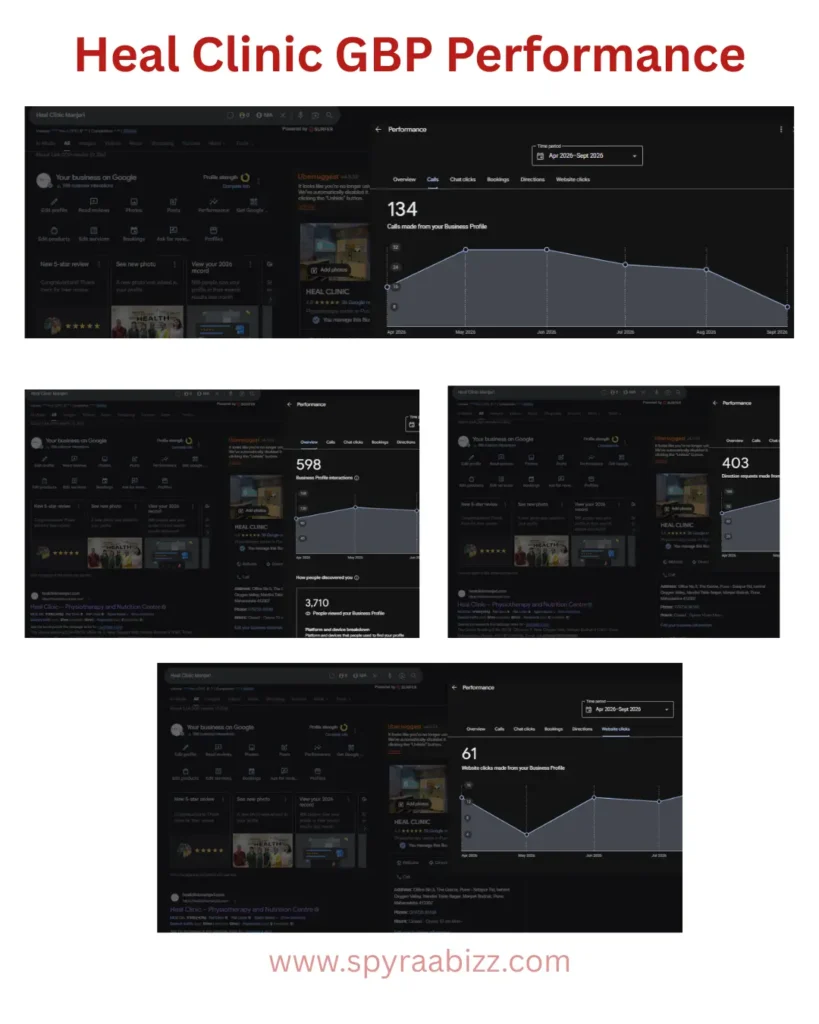
A physiotherapy clinic in Manjari came to SpyraaBizz with a basic website and an unclaimed GBP listing. No patient reviews. No individual treatment pages. The clinic was getting all its patients through word of mouth from existing patients.
Month 1: We claimed and optimised the GBP. Primary category set to ‘Physiotherapy centre.’ Services added for: Back pain, Balance exercise therapy, Foot and ankle pain, Hip pain, Hydrotherapy training, Knee pain, Neurological physiotherapy, Orthopaedics, Physical therapy, Post-surgery. 12 photos uploaded: exterior, consultation room, treatment room, before-and-after examples with patient consent. Hours and address verified.
We also set up a WhatsApp review request system. After each appointment, the clinic’s receptionist sent a short message with the review link. Within 3 weeks, the clinic had 19 new Google reviews averaging 4.8 stars.
Month 2: We built individual service pages on the website for each treatment. The hip pain page targeted ‘hip pain treatment in Manjari Pune’ in the H1. The first paragraph answered: ‘How long does hip pain treatment take?’ directly. We added the physiotherapist’s MBBS and qualifications to an author bio on each page.
Month 3: The GBP started appearing in the Local Pack for ‘physiotherapy near me Manjari’ and ‘knee pain specialist in Manjari.’ Monthly calls from GBP
Month 4: Knee pain treatment page moved to page 1. GBP calls: 38 per month. The business appeared in a Google AI Overview for one variant of its target query.
How AI Search is Changing Healthcare SEO in 2026
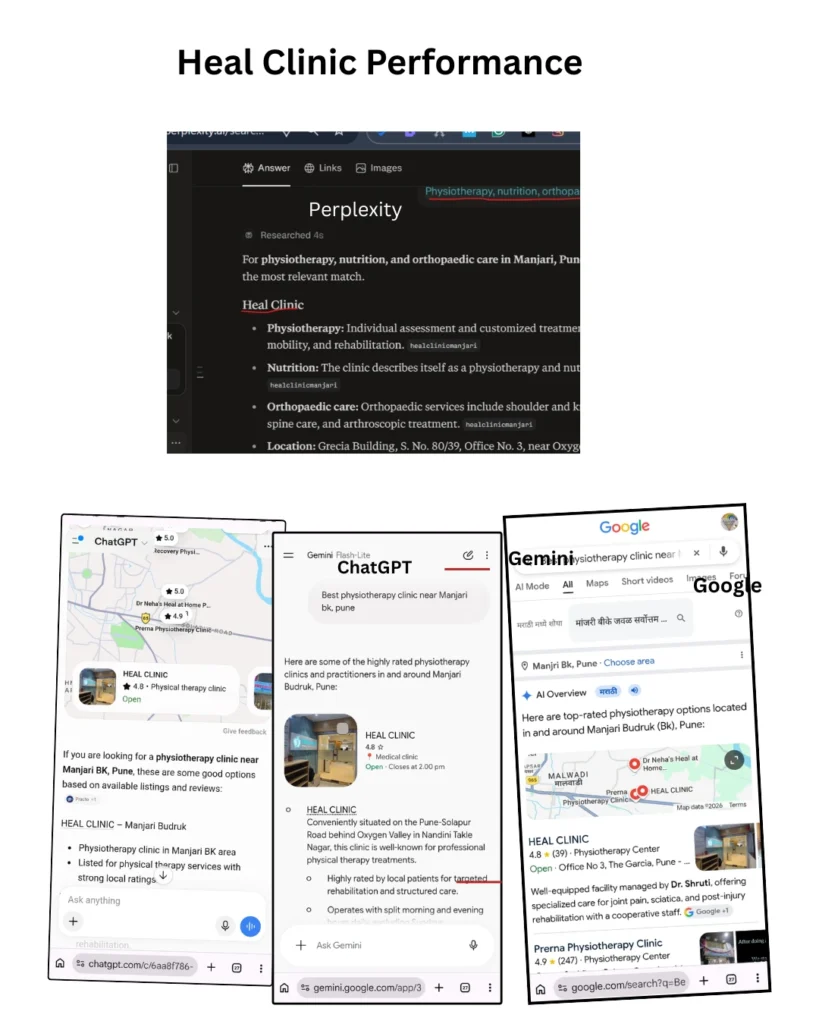
Google AI Overviews now appear on a significant share of healthcare-related searches. When a patient types ‘what type of doctor should I see for knee pain,’ they often get an AI-generated answer before any links. That answer may mention a specific type of specialist, a specific clinic, or link to specific content.
Getting cited in those AI answers requires the same foundation as traditional SEO, plus a few specific additions.
First, structure your content around questions. Every major section of your service pages and blog posts should open with the question it answers, written as an H2 or H3. ‘How long does knee replacement recovery take?’ ‘What is the difference between an orthopaedic and a physiotherapist?’ AI tools match headings to patient questions and pull from the first paragraph of the answer.
Second, add FAQ schema to your key pages. FAQ schema tells AI tools and Google exactly which parts of your page are questions and which are the answers. This is a 30-minute task for a developer and produces visible results in 4 to 8 weeks for most healthcare pages.
Third, build consistent ‘Local Business Citation Sites‘, which means brand signals. When AI tools generate an answer about your practice, they pull from your website, your GBP, your Justdial listing, your Practo profile, and any other source that mentions your clinic. If these sources say different things, the AI gets a confused picture. Consistent NAP and consistent descriptions across all platforms build the entity trust that gets your practice cited.
Common SEO Mistakes Doctors Make
Waiting for a website redesign before starting SEO
A website redesign takes months and costs money. GBP optimization, review building, and adding service pages to an existing website takes weeks and costs far less. Most clinics that put off SEO while waiting for a new website lose 6 to 12 months of ranking momentum for no good reason.
Using clinical terminology instead of patient language
A page titled ‘Lumbar Disc Herniation Management’ will not rank for how patients search. They search ‘back pain doctor near me’ or ‘treatment for slipped disc in Pune.’ SEO for doctors means using the words patients use, not the words medical textbooks use. Both can appear on the same page but patient language belongs in the headings and first paragraphs.
Ignoring Google Business Profile after setting it up
A GBP listing that was set up once and never updated loses ranking over time. Google rewards active listings. Add photos monthly. Post weekly updates (new services, health awareness content, team introductions). Respond to every review within 48 hours. These habits, done consistently, keep your listing ranking above competitors who set it up and forgot it.
Not tracking where new patients come from
SEO is measurable. Google Business Profile Insights shows how many calls, direction requests, and website clicks your GBP generates monthly. Google Search Console shows which searches bring traffic to your website. If you don’t track these numbers, you can’t tell which efforts are working and which aren’t. Set up both tools before you start any SEO work.
Expecting results in 30 days
GBP improvements typically take 4 to 6 weeks to show in local search. Website SEO changes take 3 to 6 months for meaningful ranking movement. Practices that stop after 6 weeks because they don’t see results are stopping exactly when the work was about to pay off. Set 90-day and 6-month milestones rather than 30-day ones.
F.A.Q.
Supporting Subheading
Start with Google Business Profile. Claim and fully complete your GBP listing with accurate hours, all services listed individually, 10 or more photos, and a review generation system. This alone produces results within 4 to 6 weeks. After GBP, build individual pages on your website for each specialty or treatment, optimize them for local keywords, and publish one blog post per month answering a common patient question.
GBP optimization typically produces visible results, meaning your practice appearing in local search and patients calling, within 4 to 6 weeks. Website SEO for organic rankings takes 3 to 6 months for meaningful movement. In competitive specialties like dentistry and dermatology in major Indian cities, 6 to 12 months of consistent work is needed to establish strong visibility. Most practices see new patient calls from GBP before they see results from website SEO
Yes. A small clinic in a specific area has a natural advantage in local SEO because it’s competing for a specific geographic market rather than citywide. A single clinic in Hadapsar competing for ‘physiotherapist in Hadapsar’ searches is competing against far fewer practices than a large hospital competing citywide. GBP optimization is free and produces results for small clinics within weeks.
Google Business Profile for local search visibility and E-E-A-T signals for organic content ranking. For most Indian clinics, GBP is the single most important factor because it determines whether you appear in the Map Pack, which captures patients who are ready to call. E-E-A-T matters most for content ranking: verified credentials, named authors, accurate medical information, and genuine patient reviews.
Reviews are a direct GBP ranking signal and a conversion signal. More reviews, and a higher average rating, improve your position in local search results. They also determine whether a patient who finds your listing calls you or a competitor. A consistent stream of new reviews, 2 to 3 per week, typically outperforms a one-time push of 50 reviews in terms of sustained ranking effect.
GBP alone can generate patient calls for a basic local practice, particularly for near me searches. But a website extends your visibility significantly. It allows you to rank for condition-specific and treatment-specific searches that GBP doesn’t cover, build authority through blog content, and capture patients in the research phase before they’re ready to book. A GBP without a website caps your SEO ceiling. Both together produce the best results.