

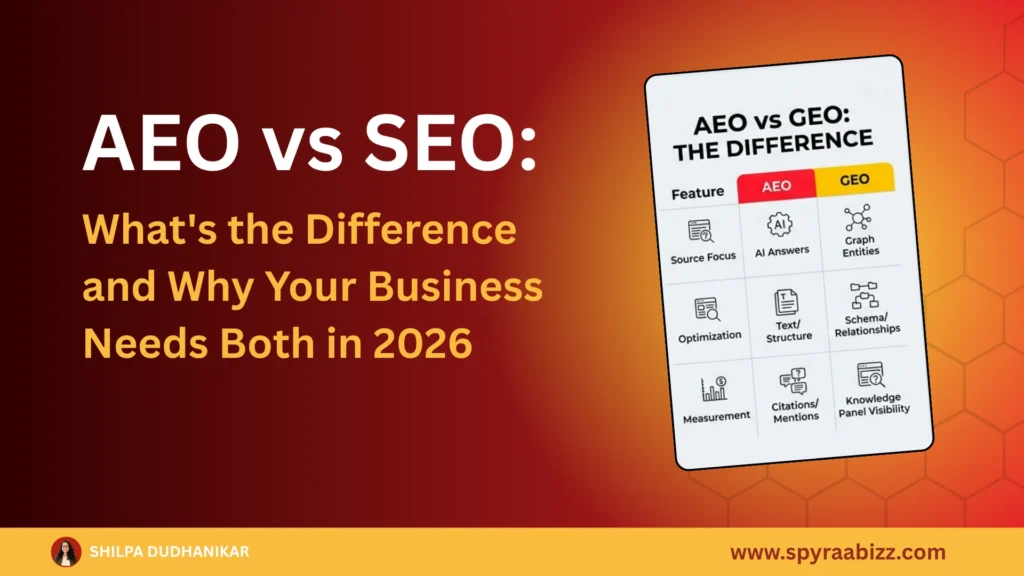
SEO helps you rank in Google’s blue link results. AEO helps your business show up inside the answer that ChatGPT, Perplexity, and Google AI Overviews generate before those links. In 2026, you need both.The catch: only 35% of pages cited in Google AI answers also appear in the traditional top 10. Strong SEO rankings alone don’t get you into AI answers
Here’s something most business owners haven’t thought about yet. When your potential customer types a question into ChatGPT or asks Google something, they often get a direct answer. Not a list of links. That answer mentions some businesses. It ignores others. And if your business isn’t in it, you’ve lost that customer before they even saw your website.
That’s the AEO problem. And most businesses in India have no idea it’s happening to them right now.
This post explains what AEO and SEO actually are, how they differ, and what a small business should actually do about both in 2026. No theory. Just what’s changed and what to do about it.
What is SEO?
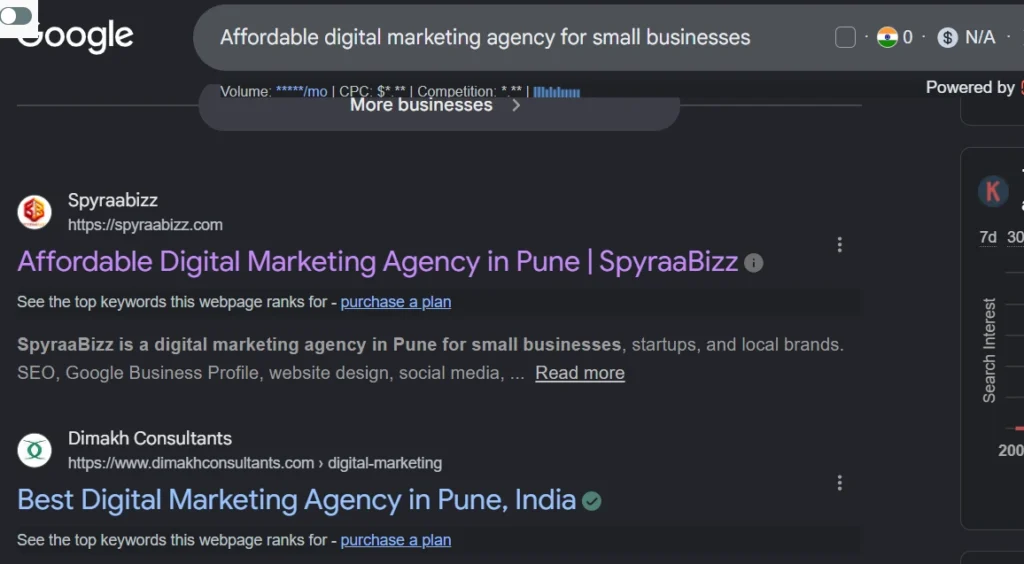
SEO stands for Search Engine Optimization. It’s the process of making your website show up when someone types something into Google. The goal is to rank in the organic results, those blue links below any ads, targeting the searches your potential customers are already using.
If someone in Pune searches ‘digital marketing agency for small businesses,’ SEO decides whether your agency appears on page 1 or page 5. Page 1 gets the clicks. Page 5 doesn’t. Google evaluates hundreds of signals, but most of them come down to three things. Content relevance: does your page actually answer what the person searched? Domain authority: how many trusted websites link to yours over time? And technical health: does your site load fast, work on mobile, and have a clean structure?
SEO has been the core of digital marketing for 25 years. It still works. Google handles 8.5 billion searches every day and organic search still drives more traffic than any other channel for most businesses. It’s not going anywhere.
But here’s what’s changed. Google doesn’t always show a list of links anymore. More and more searches now return a direct answer at the very top , before any links appear. That’s exactly where AEO comes in.
What is AEO?
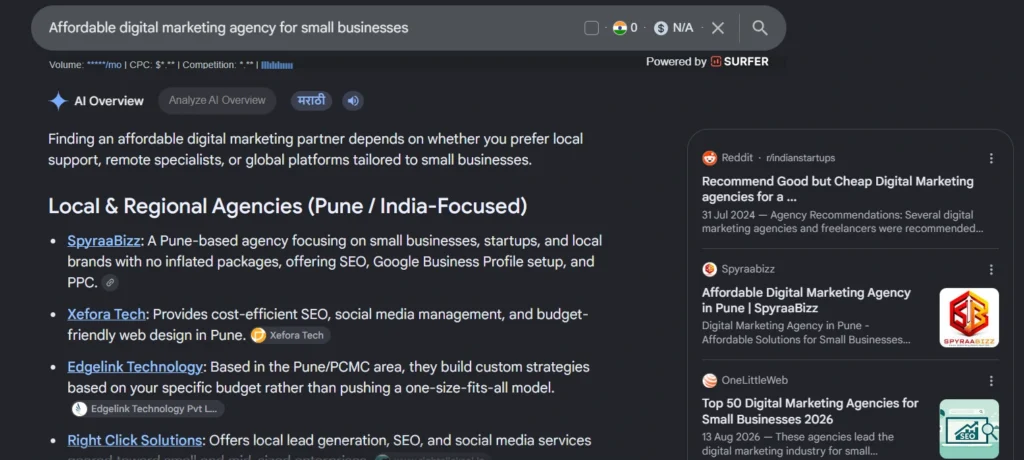
AEO stands for Answer Engine Optimization. It’s the process of structuring your content so that AI tools like ChatGPT, Google AI Overviews, Perplexity, and Gemini, to cite your business when someone asks a relevant question. The distinction matters more than it sounds. A search engine gives you a list of documents and lets you choose. An answer engine reads multiple sources, synthesizes them, and gives you one answer. It decides which brands to mention, and the person usually stops reading there.
Here’s a number worth sitting with. Only 35% of pages that Google AI cites also appear in the traditional top 10 search results. That means 2 out of every 3 pages referenced in an AI answer are pages that don’t rank on page 1 through traditional SEO. Two completely different games, with two different scoreboards.
AEO shows up in Google AI Overviews, the AI-generated summary at the very top of many Google searches. It shows up in ChatGPT when someone asks which agency or clinic or service in Pune they should choose. It shows up in Perplexity when someone does pre-purchase research. And it shows up in Google AI Mode, which is replacing the traditional search results page entirely for some queries.
Open ChatGPT right now and type: ‘what’s a good digital marketing agency for a small clinic in Pune?’ See if your business comes up. Most won’t. That’s the AEO gap.
How SEO and AEO Actually Differ
The confusion between AEO and SEO is understandable , they share common roots. Both reward content that is genuinely useful, factually accurate, and clearly written. Both benefit from a site that other respected sources link to. Both suffer from thin, recycled, or vague content. Do the work for one and you’ll almost always get a lift in the other. But beyond that shared base, the strategies pull in different directions.
Goal
SEO’s goal is to rank your page in Google’s list of results and drive clicks to your website. AEO’s goal is to get your brand mentioned inside the answer itself , before any link is clicked. For SEO, success is measured in rankings and traffic. For AEO, it’s measured in how often your brand appears in AI responses and how it’s described.
Where it shows up
SEO works in Google, Bing, and traditional search engines. AEO works in ChatGPT, Google AI Overviews, Perplexity, Gemini, and Google AI Mode. These are completely different surfaces. A business that ranks #1 on Google can be completely absent from every AI answer tool.
Content format that works
SEO rewards in-depth, keyword-rich pages that cover a topic thoroughly. AEO rewards content structured around direct questions and immediate answers. For AEO, the answer should be in the first sentence of the section, not buried after 3 paragraphs of context. FAQ schema, clear headings written as questions, and original data that no one else has published all give AEO a meaningful edge.
How you measure it
SEO has Google Search Console, rank trackers, and traffic analytics. AEO has none of that yet. You have to manually test your queries in each AI tool and note whether your brand appears, how it’s described, and what competitors are mentioned instead of you. It’s tedious, but it’s currently the only way.
What drives results
SEO is driven by backlinks, domain authority, technical site health, and keyword relevance. AEO is driven by E-E-A-T signals , Experience, Expertise, Authoritativeness, and Trustworthiness , content clarity, brand consistency across the web, and original research that no other source has published. A business with modest SEO rankings can outperform a high-ranking competitor in AEO if its content is clearer and more directly useful.
Why You Need Both in 2026
The most common question when people hear about AEO is: is it replacing SEO? The answer is no. And businesses that treat it as a replacement will get it wrong.
Think about how your own customers search. Some of them type something into Google and click a result. Some of them open ChatGPT and ask a question. Some of them check Perplexity before making a B2B decision. Search behavior is splitting across platforms, and each platform has its own logic for what shows up.
If you only focus on SEO, you rank well on Google but you’re completely invisible when someone asks ChatGPT or Perplexity about your category. Google’s own AI Overviews now appear on roughly 49% of searches, often replacing the traditional top results. If you’re not in the AI Overview, you might not get the click even if you’re ranked number 1.
If you only focus on AEO, you might appear in AI answers occasionally, but you lose the consistent organic traffic that comes from SEO rankings. Most of the buying journey still involves at least one Google search. Abandoning SEO to chase AEO would be trading a working channel for an uncertain one.
The practical reality for small businesses in India in 2026 is straightforward. SEO is your foundation. AEO is the layer on top that makes sure you’re not invisible when AI tools are used. You build both from the same content, with a few specific additions for AEO.
One more thing worth knowing: most competitors in Indian local markets haven’t started AEO yet. The window to get ahead is open right now and it won’t stay open forever.
What This Looks Like in Practice (Example)
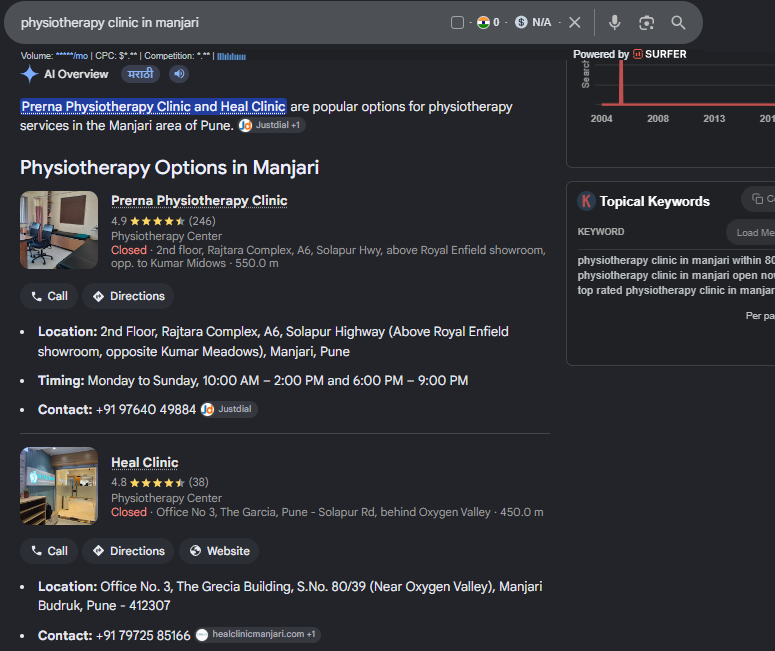
A physiotherapy clinic in Pune
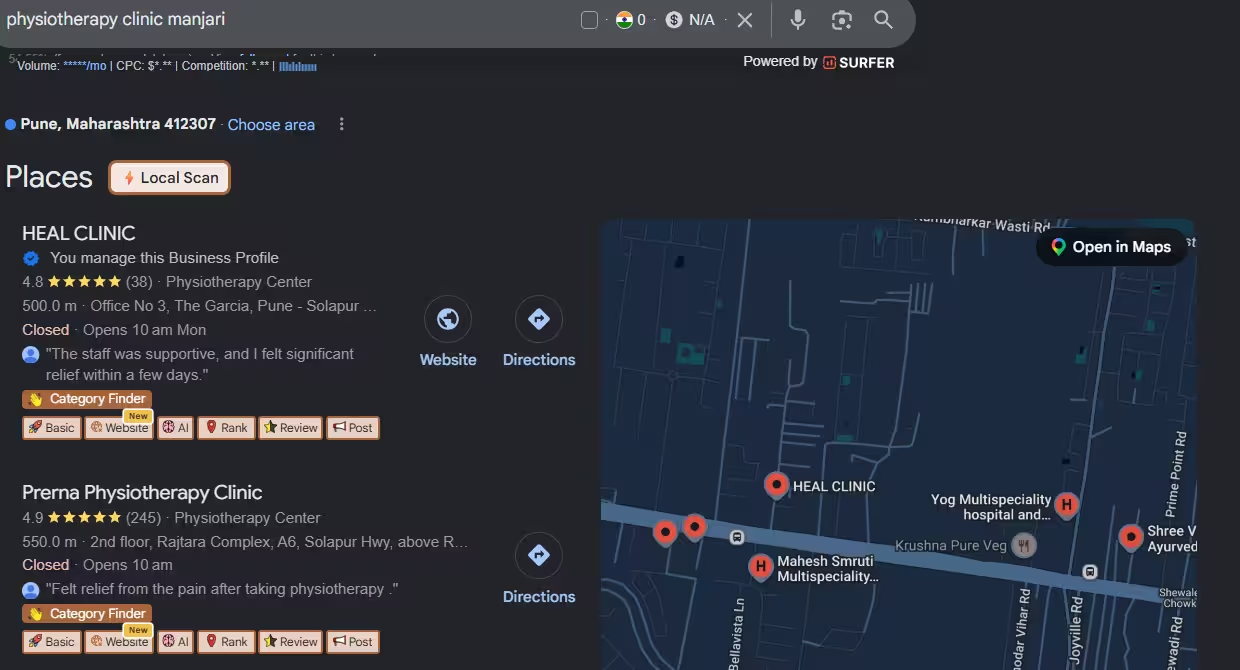
A physiotherapy clinic had no SEO at all. No website optimization, no GBP reviews, nothing. We couldn’t justify starting with AEO. Without domain authority and basic E-E-A-T signals, there’s nothing for AI tools to credibly reference.
We built the SEO foundation first: optimized GBP, individual service pages for cosmetic dermatology, acne treatment, and laser procedures, and a review generation system. After 3 months, we layered in AEO , FAQ schema, question-based headings, and a blog post titled ‘How to choose the right physiotherapist in Pune’ written to answer that exact question in the first paragraph.
That blog post now appears in Google AI Overviews for several variants of that query. The SEO foundation is what made it possible.
How to Actually Optimize for AEO
AEO isn’t a single thing you add to a page. It’s a set of habits that, over time, make your content the kind that AI tools reach for when composing a direct answer.
Step 1: Rewrite your headings as real questions
SEO headings target keywords. AEO headings answer questions. The same page can serve both if you structure it right.
‘Digital Marketing Agency Pune’ becomes ‘How do I choose a digital marketing agency in Pune?’ ‘SEO Services for Small Business’ becomes ‘What is the best SEO strategy for a small business in India?’ The keyword is still there. The structure now matches how people actually ask questions in AI tools.
Step 2: Add FAQ schema to your key pages
FAQ schema is a small piece of structured code that tells AI tools exactly which parts of your page are questions and which are the answers. Prioritize your homepage, service pages, and any blog post that covers a major question in your space. Write the questions in plain, conversational language , the kind of thing a real person would actually type, not polished marketing copy.
Step 3: Answer the question in the first sentence
AI tools don’t read your whole page before deciding what to cite. They look for the most direct answer to a question and pull from that. If your page takes 3 paragraphs to get to the answer, the tool skips it.
Right: ‘SEO typically takes 3 to 6 months to show meaningful results for most small businesses.’ Wrong: ‘Many factors influence SEO timelines. Let’s explore what they are before discussing results…’ The answer always comes first. The explanation follows.
Step 4: Publish original data that only you have
AI tools prefer referencing information that isn’t available anywhere else. Generic content that covers the same ground as 20 other sites has no advantage here. But a specific data point from your own experience , the average time it took your clinic clients to appear in the 3-Pack after GBP optimization, the percentage of leads that converted after implementing WhatsApp automation- becomes something worth citing precisely because no competitor can produce the same number.
Step 5: Make your brand look the same everywhere
When an AI tool compiles a response about your business, it pulls from your website but also from Google Business Profile, reviews, directories, and forum mentions. If those sources say different things, the tool gets a confused picture. Audit your GBP description, Justdial listing, Sulekha profile, and any directory where your business appears. Get the descriptions consistent, current, and specific.
Step 6: Test what AI tools say about you , every week
There’s no dashboard for this. You have to go looking. Pick 10 to 15 questions relevant to your business and run them in ChatGPT, Perplexity, and Google’s AI Overviews every week. Note whether your business appears, how it’s described, which competitors are mentioned instead of you, and whether anything said about you is outdated or wrong. That weekly habit is the foundation of any serious AEO effort.
SEO or AEO: Where Should You Start?
For most small businesses, the answer depends on what’s already in place. If you have no website or your site has never been optimized, start with SEO. AEO needs a credible foundation to reference. Without basic SEO in place, AI tools have nothing to cite about your business.
If your SEO is solid but your pages have no FAQ schema and headings aren’t structured as questions, adding AEO-specific elements is fast and the ROI is immediate.
If you’re ranking on page 1 for your key terms but missing from AI answers entirely, that’s the 35% gap in action. AEO is where your effort should go right now.
If you’re a local service business like a clinic, salon, or coaching institute , start with GMB and local SEO first. Local visibility is the fastest ROI. AEO matters more once that foundation is solid.
If you’re in B2B or professional services, AEO deserves attention early. B2B buyers increasingly use AI tools to research before making contact. Getting your brand mentioned in those responses can influence decisions before a website is ever visited.
If you’re starting from zero with a new business, run both tracks simultaneously. Set up GBP, basic on-page SEO, and AEO-structured content from the beginning. It’s much easier to build it in from the start than to retrofit it later.
Mistakes Businesses Make with AEO
Treating AEO as a replacement for SEO
It’s not. SEO is still driving the majority of website traffic. Businesses that abandon SEO to chase AEO are trading a working channel for an uncertain one. Build both.
Burying the answer deep in the content
AI tools need to find the answer quickly. If your answer to a common question is in paragraph 7 of a 2000-word post, it won’t get cited. Answer first. Explain after. Every time.
Publishing generic content that matches dozens of other sites
AI tools have no reason to cite you if 15 other sites have said exactly the same thing. Your original experience, your real client data, and your specific local knowledge are your competitive advantage. A data point from your own client work will outperform a perfectly written generic page in AI citations almost every time.
Checking once and forgetting about it
AI responses change constantly. A business that was mentioned in ChatGPT’s response last month might not be there this month if a competitor published better content. Monitoring has to be regular. Not a one-time audit.
Ignoring E-E-A-T signals
Experience, Expertise, Authoritativeness, and Trustworthiness. These are the signals that tell AI tools your content is worth citing. Real author names, real credentials, original data, and factually accurate content that’s kept up to date. Generic content from an anonymous source won’t get cited consistently, no matter how well it’s structured.
Frequently Asked Questions
SEO helps your website rank in Google’s traditional blue link results. AEO helps your business get cited inside the direct answers that tools like ChatGPT, Perplexity, and Google AI Overviews generate. Both target different places on the search results page and require different content strategies to execute well.
No. AEO is not replacing SEO. Google still processes 8.5 billion searches every day and organic rankings still drive significant traffic. What’s changed is that a growing share of searches now return AI-generated answers before any links. Businesses that ignore AEO will be invisible in those answers. The right strategy is to build both.
Open ChatGPT, Perplexity, and Google and run the questions your customers would ask about your category. Check whether your business is mentioned, how it’s described, and which competitors appear instead of you. There’s no automated dashboard for this yet , it requires regular manual testing, at least once a week for your most important queries.
Add FAQ schema to your most important pages and rewrite your headings as direct questions. These two changes tell AI tools exactly which questions your page answers and where the answers are. Businesses that have done this report appearing in AI Overviews within 4 to 8 weeks for queries they weren’t showing up in before.
AEO works particularly well for small businesses in India right now because most local competitors haven’t started optimizing for it. A well-structured FAQ section on a small business website can outperform a large corporate site in AI answers if the content is clearer and more directly useful. The window to get ahead is open now.
E-E-A-T stands for Experience, Expertise, Authoritativeness, and Trustworthiness. It’s the standard Google uses to evaluate whether content is worth surfacing, and it applies just as much to AEO as to traditional SEO. In practice it means putting real author names and credentials on your content, citing sources, keeping information accurate and up to date, and building genuine expertise in a specific area rather than publishing broadly on topics you don’t have real experience in.